Effiniti
The first true self-adaptable Layer 1–4 fabric
for unified adaptive datacenter networks.
Effiniti unifies AI/HPC, storage, applications and management into a single network that dynamically optimizes its physical paths per-flow, eliminating the multi-network crisis and unlocking massive efficiency, cost and scalability benefits.
GPUs stop waiting for the network
near direct-fiber latency
three networks become one
CapEx, OpEx and energy combined
The Problem
Today's data centers run three or more separate networks: AI/HPC, storage and applications (plus management). Each network has dedicated hardware, cabling and operational overhead. The result: over 32% of xPU time is spent waiting for data, xPU utilization sits below 45% and a $50M xPU cluster wastes $27M in stranded compute. This crisis exists because Layer 1 (the physical layer) has always been static: fixed fiber paths that cannot adapt to traffic demands in real time.
Existing approaches like SDN with Optical Circuit Switching attempt to address this but suffer from fundamental mismatches: millisecond-scale controllers trying to optimize microsecond flows, network-wide changes when per-flow granularity is needed and disruptive reconfiguration that breaks active sessions.
The Effiniti Solution
The fix is not a faster controller on top of a static physical layer. It is a physical layer that adapts on its own.
Effiniti makes Layer 1 intelligent and self-adaptable, not just programmable, just like the layers above it. Our Dynamic Optical Bypass technology creates dedicated physical paths on demand, delivering latency comparable to a direct fiber connection while reducing hop count from 3–5 to just 0–2. The physical infrastructure continuously reconfigures per-flow, without disruption, at microsecond speed.
Unlike SDN+OCS, Effiniti treats physical reconfiguration as normal operation, not a disruptive event. Every layer is co-designed so that continuous physical changes happen seamlessly, with zero packet loss. Effiniti is an Ethernet top-of-rack switch plus card software: not just an optical switch, not just photonic switching, not just co-packaged optics, not just a packet switch. Whether a link is formed electronically or optically inside the switch is an implementation choice.
How It Works
Effiniti's architecture rests on two tightly integrated components and a distributed intelligence model that eliminates centralized bottlenecks. The switch reshapes the physical layer. The card decides, per flow, what the physical layer should be. Neither waits on a central controller.
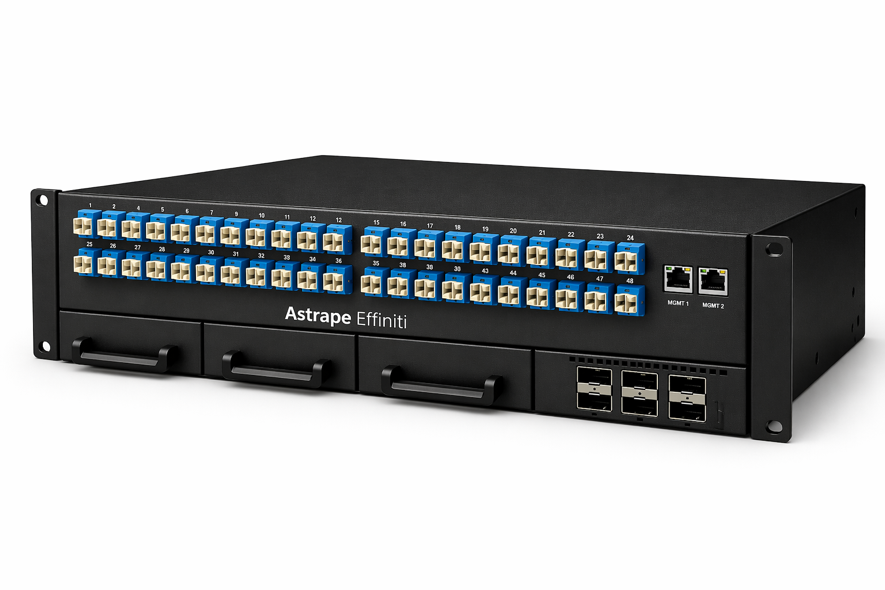
Effiniti Switch
- Full Layer 1–4 integration in a standard 2U form factor
- Creates optimal optical bypasses in 150 microseconds, without disrupting active traffic
- 100 Gb/s to 1.6 Tb/s per port, 48–256 ports per switch
- Drop-in compatible with existing data center infrastructure
- Hot-swappable electro-optical modules for continuous, non-disruptive operation and incremental upgrades
Effiniti SNIC (Switching NIC)
- Distributed intelligence: each NIC independently detects, classifies and optimizes flows
- Classifies traffic type within 2–3 packets
- Zero-wait operation: traffic flows immediately while optimization occurs in parallel
- Seamless path migration with zero packet loss during transitions
- Open platform: standalone card or integrated into partner SmartNIC/DPU, no vendor lock-in
Before and After Effiniti
What changes in practice is where your capacity goes. Instead of three networks each provisioned for its own peak, one network serves whatever is asking for it.
- 3+ separate networks to build and maintain
- Fixed fiber paths for all traffic types
- Reconfiguration takes hours, causes disruption
- Stranded capacity across each network
- 1 unified network for all workloads
- Physical paths adapt per-flow automatically
- Optical bypasses created in 150µs, zero disruption
- Every port dynamically serves any workload
Why Existing Approaches Fall Short
The closest comparison is SDN with optical circuit switching. It aims at the same problem from the opposite direction: a central controller steering a small number of circuits. That is where it runs out of room.
| SDN + OCS | Effiniti | |
|---|---|---|
| Optimization speed | Milliseconds–seconds | 150 microseconds |
| Latency | 3–5 hops | 0–2 hops (near direct fiber) |
| Granularity | Network-wide circuits | Per-flow |
| Scale | Dozens of circuits | Millions of flows |
| Disruption | Breaks active sessions | Zero packet loss |
| Intelligence | Centralized controller | Distributed (per SNIC) |
| Upgradability | Forklift replacement | Hot-swappable modules, incremental upgrades |
The Business Case
Effiniti collapses three or more separate networks into one dynamically optimized infrastructure, delivering compounding savings across capital, operational and energy costs. The savings compound because they come from the same change: you stop buying, cabling, powering and staffing the same capacity three times over.
Capital savings
- 50–70% lower CapEx
- Single cabling infrastructure
- Fewer transceivers via dynamic allocation
Operational savings
- One network to manage
- Any port serves any workload
- Simplified troubleshooting
Energy savings
- 70%+ network energy reduction
- Direct optical paths eliminate intermediate processing
- No redundant network power
Dynamic Configuration Per Workload
Effiniti adapts the physical network to each flow's requirements independently and simultaneously:
| AI / HPC | Dedicated optical bypasses with zero buffering for maximum throughput in distributed training |
| Storage | Persistent, high-throughput paths optimized for sustained data movement |
| Applications | Flexible packet-switched connectivity for general-purpose traffic |
| Mixed | Each flow independently optimized, no compromise between workload types |
Product Roadmap
The pilot hardware is available now and the line scales with port speeds as they arrive, so an early deployment grows rather than gets replaced.
| Product | Availability | Ports | Target |
|---|---|---|---|
| EFFINITI-100 | Q3 2026 | 24 × 100G | Pilot-ready prototype |
| EFFINITI-200 | Q4 2027 | 48 × 800G | Entry-level unified networking |
| EFFINITI-600 | Q1 2029 | 72 × 1.6T | Mid-range solution |
| EFFINITI-2000 | Q4 2029 | 256 × 1.6T | Enterprise-scale |
| EFFINITI-8000 | Q4 2030 | 256 × 3.2T | Hyperscale (16M+ servers) |
The Bottom Line
Astrape Networks has achieved what the industry has pursued for decades: making the physical layer as intelligent and self-adaptable as the logical layers above it. Effiniti's co-designed architecture enables continuous, non-disruptive optimization, allowing organizations to replace multiple service-specific networks with a single, unified infrastructure that dynamically adapts to every workload.
Impact
- 2× xPU utilization (from <45% to 85%+)
- 70%+ network energy reduction
- 50–70% cost savings
- 16M+ server scalability
Differentiation
- True Layer 1–4 self-adaptable fabric
- Near direct-fiber latency (0–2 hops)
- 150µs optical bypass, zero disruption
- Physical-layer security, zero overhead
Request more information
Want to go deeper than this page? Tell us what you're looking at and we'll come back to you, whether that's technical detail, a walk-through with our engineers or how Effiniti would drop into your infrastructure.